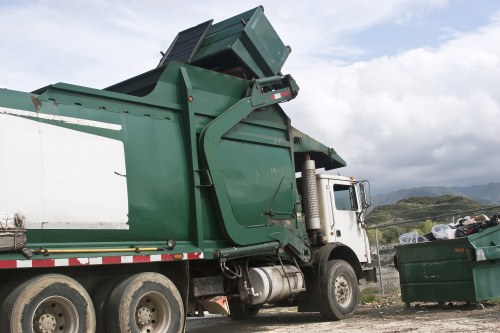
Health and Safety Policy — Office Clearance Docklands
This policy sets out the principles and practical controls for carrying out office clearance and associated waste operations safely across our service area. It applies to all staff, contractors and visitors involved in commercial and Docklands office clearance, including removal of furniture, fixtures, and general rubbish. The aim is to protect people, property and the environment by reducing hazards connected with every stage of a clearance project.All personnel must observe the policy and the detailed procedures that flow from it. The policy promotes a culture of responsibility: managers will assess risks, provide training, monitor compliance and ensure appropriate equipment is available, while employees must use controls, report hazards and follow safe working practices. This commitment supports effective rubbish removal Docklands operations while minimising harm.
 Scope and objectives: This document covers planning, on-site work, transport, temporary storage and final disposal related to office clearances and waste clearance activities. Objectives include preventing accidents, controlling manual handling injuries, managing hazardous items, reducing environmental impact and ensuring safe use of vehicles and mechanical aids during Docklands office clearance projects.
Responsibility and accountability are central. Senior management are responsible for policy implementation and resourcing. Supervisors coordinate day-to-day safety on site for each office clearance job and must ensure a competent team is present for rubbish company tasks. Employees are responsible for following instructions, using PPE and reporting unsafe conditions without delay. Contractors engaged for specialist disposal retain responsibility for how they perform contracted activities.

Risk assessment and safe systems of work
Before any clearance, a documented risk assessment must be carried out to identify hazards such as: manual handling of heavy items, sharps or contaminated waste, unstable shelving, electrical risks, fire hazards and traffic movements. From assessment, a safe system of work will be prepared that includes control measures like mechanical lifting aids, team lifts, signage, segregation of waste streams and isolation of live services when necessary.Key controls for rubbish removal and office clearance services include use of PPE (gloves, high-visibility clothing, safety boots, eye protection where required), safe lifting techniques, restricting access to the work area, and implementing traffic management for vehicle movements. Supervisors must ensure that tools and equipment are inspected and that electrical items are handled in line with safety guidance.
Training and competence are essential for safe waste clearance. Staff will receive induction training covering hazard awareness, manual handling, hazardous substance recognition and emergency procedures. Refresher courses and task-specific training (e.g., operating tail-lifts or compacting equipment) will be provided. Competence records shall be maintained and reviewed.

Operational controls and emergency arrangements
During site operations, a permit-to-work or job brief may be used for complex jobs. Emergency arrangements include first-aid provision, spill kits for liquid waste, procedures for dealing with sharps or asbestos suspect items and clear instructions for evacuation. Any incident, near-miss or injury must be reported immediately and investigated to prevent recurrence.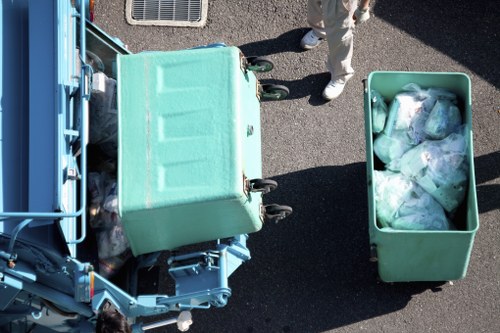 Waste segregation and hazardous items: The rubbish company team will separate recyclables, confidential paper, electronics and non-hazardous general waste. Hazardous materials (e.g., certain chemicals, batteries, contaminated items) will be identified and handled only by trained personnel with appropriate containment and documentation. Records of hazardous waste transfers and waste consignment documentation must be maintained in accordance with good practice.
Vehicle and traffic safety for office clearance operations requires careful planning. Drivers must comply with road safety and load security measures. Loading and unloading zones should be organised to minimise interaction with pedestrians and other site activities. Vehicles used for Docklands office clearance work must be maintained, checked daily and operated by trained staff.
Monitoring, review and continuous improvement: The effectiveness of this policy will be monitored through inspections, audits and review of incident data. Regular toolbox talks, site reviews and audits will inform updates. The policy will be reviewed annually or after any significant change in work methods, equipment or following an incident.
Implementation details: managers will ensure documented procedures, checklists and risk assessments are available for each job, and that training records and equipment maintenance logs are kept. A small checklist for on-site supervisors should include: pre-job briefing, PPE checks, control of traffic, segregation of waste, and confirmation of safe vehicle access. Employees are encouraged to contribute to safety improvements by suggesting risk control measures and reporting hazards.
Conclusion: This health and safety policy provides a clear framework for safe operations during office and rubbish clearance activities in the Docklands service area. By following the outlined responsibilities, risk assessments, training, and safe working procedures, the likelihood of harm to people and the environment will be minimised. Commitment at all levels is required to maintain safe, compliant and efficient office clearance services.
Appendix — quick reference list of controls and actions:
- Carry out and document risk assessments for each job;
- Provide appropriate PPE and mechanical lifting aids;
- Ensure training and competence for all staff and drivers;
- Segregate waste streams and manage hazardous materials properly;
- Implement traffic management and secure loads on vehicles;
- Report and investigate incidents; review procedures regularly.
This policy is subject to periodic review and should be read in conjunction with standard operating procedures for specific tasks and equipment used in office clearance and waste removal services.
